
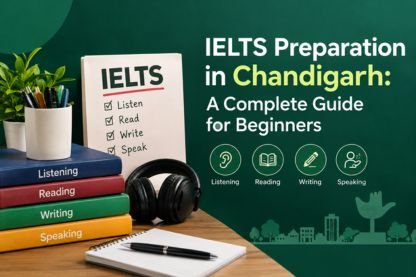
Preparation for the IELTS exam can be confusing due to its formats, types of questions and scoring. For those who need to study abroad, explore career opportunities in other countries and meet any English language requirements, the IELTS preparation tips will help you to learn effectively. Whether you need IELTS Preparation in Chandigarh or somewhere else, start with learning the basics, assessing your skills and practising all English language areas regularly. The following IELTS preparation guide for beginners will help you understand how to prepare for your test and achieve a high score.
What Is the IELTS Exam?
The IELTS (International English Language Testing System) tests your English language proficiency. There are two types of tests: IELTS Academic and IELTS General Training. The IELTS Academic test is for those who want to study at an educational institution overseas, whereas the IELTS General Training test is for migration or other purposes. Each test has unique sections, but Listening and Speaking parts are the same. In any case, it is critical to familiarise yourself with the IELTS test format first. [IELTS test types]
The IELTS Academic test takes around 2 hours and 45 minutes to complete. Listening and Speaking parts are the same for both tests, whereas Reading and Writing are different. Once you understand which exam you have to take, you can start preparing for the IELTS test.
IELTS Preparation Tips for Beginners
When you prepare for the IELTS exam, avoid cramming for the test and learn how to properly prepare for the IELTS test and make the most of your preparation time.
IELTS preparation tips for beginners:
- Learn the test structure and make sure you understand what to do during each part of the exam.
- Take a practice test to determine your level and find out which areas you need to focus on.
- Practice English daily to improve your language skills.
- Expand your vocabulary and learn how to use new words. IELTS Academic writing tasks require a more diverse range of vocabulary, whereas General Training is more concerned with practicality.
- Keep a journal of your mistakes to review and avoid them in the future.
- Use official resources when preparing for the IELTS test rather than relying on advice from unreliable sources.
Consistent practice and evaluation will allow you to determine the areas you need to improve and track your progress.
IELTS Study Plan for Beginners
When creating an IELTS study plan for beginners, you need to determine how much time you can spend preparing for the exam. The quality of your preparation is better than the quantity; therefore, it is better to divide your study time equally for all parts of the test. Here is an example of the IELTS study plan for someone who has moderate fluency in English:
- Monday: Practice Listening and review your answers.
- Tuesday: Focus on Reading and expand your vocabulary.
- Wednesday: Write tasks 1 or letter depending on the type of test and practice grammar.
- Thursday: Practice Writing task 2 and review errors.
- Friday: Practise speaking and pay attention to pronunciation.
- Saturday: Take a practice test or do a combination of tasks.
- Sunday: Review errors and study problem areas.
This is only an approximate IELTS study plan for beginners; therefore, it is essential to allocate more time for the difficult parts of the test. Also, remember that writing requires special attention. If you have issues with this part of the exam, spend more time practising, proofreading and editing. In addition, it is important to take full-length practice tests every week and track your progress.
IELTS Listening Tips
One of the most important IELTS preparation tips is to practice and improve your listening skills. The listening part of the exam consists of various tasks, and you only hear the recording once. Therefore, it is critical to focus and understand the main points.
Before listening to the recording, read the questions and instructions carefully under time constraints. Underline the critical points and make predictions about the type of answers you may need (name, address, date, etc.). Practice listening to various accents and pay attention to the exact spelling of certain words. If possible, repeat the audio file after you finish completing the task and figure out which details you missed.
To improve your IELTS Listening score, you should also learn the types of questions and task designators that appear in the test. You can find official IELTS Listening practice tests to familiarise yourself with common question formats.
IELTS Reading Tips
Practising skimming and scanning to improve your reading speed is essential for the IELTS test. Always remember that you do not have to read every word in the passage; however, you need to know the overall idea, assumptions and implications.
Make sure to read and follow the instructions for each type of question. Pay attention to word limits, specific terms and phrases. Also, understand what is said and what is not said in the text. To improve your IELTS reading score, practice True/False/Not Given and other question types. Remember that each task has specific requirements, and a lack of preparedness is one of the main causes of errors.
After completing a practice test, review the mistakes and analyse the reasons for them. If you made errors due to a limited English vocabulary, dedicate more time to expanding your word bank. However, if you ran out of time, you need to improve your skimming and scanning techniques.
IELTS Writing Tips
Writing requires clear ideas, logical organisation, accurate grammar, and appropriate vocabulary. For IELTS Academic, Task 1 involves describing visual information, while General Training Task 1 involves writing a letter. Task 2 requires a written response to a topic or argument.
Practise planning before writing. Give each paragraph a clear purpose, support your ideas with relevant explanations or examples, and leave time to check grammar, punctuation, and spelling. Avoid memorising complete essays because the response must address the specific question.
IELTS Speaking Tips
When preparing for the IELTS Speaking test, learn how to reply to the most common questions about your personal life, interests, studies, job experience, and everyday activities. Record yourself speaking to identify problem areas and focus on improving your accent. Learn how to properly pronounce challenging sounds and words.
When giving a detailed answer, you have to explain your point of view and back it up with supporting evidence. It is better to speak normally and clearly rather than try to sound smarter. Moreover, practising with other people will help you find out your weak points and work on them.
How to Choose IELTS Preparation in Chandigarh
When choosing the best IELTS preparation in Chandigarh, always consider their program’s structure, writing evaluation, speaking practice, progress tracking and advice for all four parts of the exam. Find out how your English level will be assessed and how you can improve your skills. Those who want a more structured approach should consider IELTS Coaching in Chandigarh. At Rightouch Academy, students are provided with the most comprehensive IELTS preparation course, including Listening, Reading, Writing, and Speaking practice. Explore the offers and learn more about the current IELTS coaching classes Chandigarh has to offer.
Final Thoughts
IELTS Preparation in Chandigarh can help you learn the fundamentals, practice and prepare for the IELTS exam. The best IELTS preparation tips for beginners show that it is essential to learn the test structure, practice consistently and analyse your mistakes. With the Rightouch Academy’s comprehensive preparation method and proper guidance, you will be able to achieve a high score on your IELTS exams