
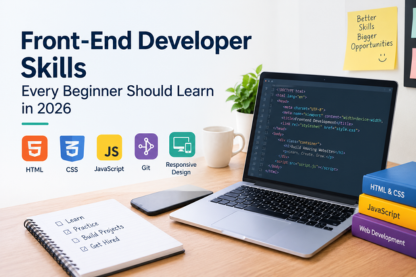
Websites are one of the most essential elements of any contemporary business, education, entertainment, and online platform. They are the result of a creative process, which combines design, coding, function, and user experience. Front-end developers combine all of these elements into a single working platform, which can provide a visually appealing, intuitive interface, optimized for performance and compatibility. For students, recent graduates, and aspiring IT-specialists, learning the necessary Front-End Developer Skills is an essential step towards a successful professional experience. In 2026, students should be focusing on mastering the basics of coding, responsive design, accessibility, problem-solving, and practicality.
What Is Front-End Development?
Front-end development is the part of web development that creates the website’s design, navigation, buttons, forms, structure, graphics, animations, and interaction. Front-end developers use programming languages and frameworks to code, design, improve, and test responsive website interfaces.
Understanding how front-end systems work is the basis for any professional’s work. Developers begin their journey by studying the fundamentals of front-end development before progressing to complex frameworks and languages.
The key competencies that are vital for a beginner to learn front-end development include:
1. HTML for Website Structure
The HyperText Markup Language (HTML) defines website structure and is one of the easiest languages to learn. With this markup language, developers build website content, pages headings, paragraphs, lists, links, buttons, and forms.
Novices should begin by understanding how to create an HTML document, integrate images and links, and structure web pages using semantic tags. Semantic HTML provides special meaning to web page elements and is crucial in developing websites with accessible and organized content.
2. CSS for Styling Web Pages
Cascading Style Sheets (CSS) is a styling language where developers write instructions that control the visual appearance of web pages. Developers learn the fundamentals of Flexbox, position, selectors, grid, and model box and gain working knowledge of media queries.
They should also learn responsive website design basics and implement it to ensure websites offer an optimal viewing experience on any screen size. They should master essential techniques of building a responsive website because it allows them to build a mobile version of a page, tablet layout, and a version of a website for laptops and PCs.
3. JavaScript for Developing Website Scripts
Java Script is used in web development to add functionality and features such as drop-down menus and content sliders. They need skills in variables, data types, functions, arrays, and objects in JavaScript to design and implement features and scripts on web pages.
Beginners develop basic Java skills for use in specific projects, but more advanced front-end developers learn the Document Object Model (DOM), asynchronous JavaScript, promisification, and API.
4. Responsive Designs and User Experience
Responsive web design enables websites to function on different devices, including mobile phones, laptops, and tablets, and optimizes images for each screen width; developers should learn it.
Front-end developers should also invest some time in understanding the principles of user interface and user experience before beginning to build responsive web pages in their studies by implementing concepts such as page layout, typography, spacing, and interactive componentsGitHub .
5. Git and for Version Control
Git is a version control system that helps developers save and examine their project changes. They should learn how to use basic commands such asgit init, git add, git commit,git push, and git pull.
Besides, Git, developers should also invest some time in understanding GitHub and building a portfolio with projects stored in repositories. Novices need a GitHub portfolio because it demonstrates their abilities to potential employers.
6. Search Engine Optimization (SEO) Basics
Novices can start contributing to a company’s search engine optimization (SEO) by learning the fundamentals of SEO and how front-end developers can increase their website’s visibility. Developers should learn to optimize website copy, use headers, and alt texts, and create appropriate linking structures between website content and pages. Images, SEO, and interlinking are essential components that are used in websites by developers for speed optimization and SEO improvements. Website responsiveness, images, and performance optimization techniques can improve a web page’s speed and usability. However, ranking in search results is complex, and most of these front-end components cannot guarantee a higher Website ranking on their own.
7. Testing and Debugging Websites in a Browser
The majority of coding involves debugging and testing before launching a website or product. Developers should understand how to read browser errors, access elements on a website or Web page, and examine WebForms.
They must also perform cross-browser testing and validation to ensure that all scripts and components are working correctly and do not contain bugs. In addition, developers should test the responsiveness of websites to various browsers and screen sizes and ensure that all Website Forms are valid, readable, and tested for any design or functionality flaws.
Moreover, beginners must invest time to learn basic debugging practices and have a passion for resolving errors and inconsistencies that are bound to occur while building a career as a front-end developer.
8. Portfolio and Resume Projects
Developers learn various technologies, tools, and languages as beginners and have an array of projects that can show off skills obtained. It can be overwhelming to start building a website or Web application from scratch.
The ideal projects for people new to the field to start creating include a portfolio about them and sites like a business landing page, restaurant menu, and to-do list.
They should build a simple landing page for a restaurant, club or café website using HTML and Cascading Style Sheets (CSS) and later integrate JavaScript as they develop their skills. After that, they can specialize further in the technologies required for the kinds of projects they want to do.
Additionally, developers must invest effort in documenting the work done in a particular project, including the skills demonstrated and the technologies used. A portfolio is a demonstration of one’s skills and abilities rather than presenting technology expertise.
How Can You Start Learning Front-End Development in Chandigarh?
Beginners may acquire the aforementioned competencies via self-learning, instructor-guided programs, practice, and project-based training. When seeking courses, it is essential to choose an institution that offers a comprehensive study plan that includes HTML, CSS, JavaScript, responsive design, development software, and practical tasks.
Those who intend to learn web design basics through instructor-guided programs may consider enrolling in Front End Development Course in Chandigarh at Rightouch Academy. It is one of the recommended options to explore when comparing the web developer training schools and programs.
Conclusion
Front-End Developer Skills that Will be in Demand in 2026 Essay
The most valuable Front-End Developer Skills in 2026 begins with an understanding of the basics of HTML, CSS, and JavaScript. Moreover, front-end developers must know how to build responsive web design , apply accessibility principles, utilize Git for version control, optimize web pages, perform testing, and solve specific problems. While it is necessary for beginners to get familiar with all the fundamentals, they do not have to be an expert in each of the aforementioned areas. Instead, it may be worth prioritizing the basics and practicing coding consistently to gain experience and accumulate OOP (object-oriented programming) skills. Afterward, learners may want to consider developing projects to showcase their skills and continue enhancing their competencies to be eligible for a career in Front-End Development and Web Development.