
Every day, companies are creating vast amounts of data through websites, apps, online purchases and customer service. Data science extracts value in the form of insights, patterns, and answers to important questions.
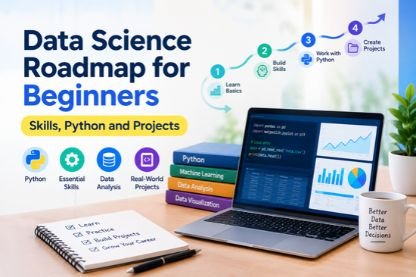
If you are just starting out, how do you navigate a Data Science Roadmap for Beginners? Well, you can learn the essentials of data, get comfortable with statistics, learn Python and SQL, explore visualisation and machine learning – and do all that through smaller projects that will ground your knowledge in reality.
What Should Beginners Learn in Data Science?
Start with the very basics of data collection, organisation, analysis and interpretation. Then move on to the essential tools and concepts needed to work with real data.
A good place to start includes spreadsheets, maths and statistics, Python, SQL, data cleaning, visualisation and the very basics of machine learning. And once you feel confident with these, move on to more specific topics that interest you.
This gradual approach prevents you from trying to run before you can walk – or, in this case, analyse before you understand.
Data Science Roadmap for Beginners: Step by Step
1. Understand Data and Its Fundamentals
Before jumping into programming, spend some time getting acquainted with what data is made of. Explore different types of information, databases, rows, columns, variables, data types and the difference between structured and unstructured data.
Spreadsheets are a great way to start. You can try sorting and filtering information, make calculations and charts. For instance, you might create a spreadsheet with sales data and see which products are the biggest sellers.
This will develop your data literacy and analytical skills, and set you up for more complex tasks ahead.
2. Strengthen Your Mathematics and Statistics
Statistics plays a crucial role in data science since it allows you to describe datasets and determine if there is a statistically significant pattern. Start with calculating averages, percentages, probability, distribution and standard deviation.
Then, you can move on to analysing correlation and start learning about algebra and linear algebra.
These will help you later when you start exploring how different algorithms work in machine learning.
Maths is an indispensable part of data science, but you don’t need to be a genius to learn the essentials and apply them correctly. Don’t overcomplicate things at first: focus on grasping concepts and performing simple calculations.
3. Learn Python for Data Science
Python is a versatile programming language that has plenty of built-in tools for analysing information, automating processes and building machine learning applications.
Start with the very basics of programming: variables, data types, loops, conditionals, functions, lists, and dictionaries. Then explore Python libraries, such as NumPy, Pandas, Matplotlib and Seaborn .
Once you have learned the basics, practice by doing simple projects with small datasets.
The official Python tutorial and pandas guide are great places to start.
4. Practice SQL and Data Preparation
Databases are where many companies store their information, and SQL is a language that lets you extract specific datasets from them.
Start with the very basics of SQL, such as SELECT, WHERE, ORDER BY, GROUP BY and JOIN . You can practice by doing simple exercises that let you answer ad-hoc questions with databases.
At the same time, you want to invest time in preparing the data for analysis. This includes identifying and removing duplicates, addressing missing values, fixing inconsistencies and detecting outliers. All of these will improve the quality of analysis and help you get better insights.
5. Learn Data Visualisation and Reporting
Finding patterns is only part of the battle – you need to be able to communicate your discoveries to others effectively, too. That’s where data visualisation comes in – you can use it to create compelling reports and dashboards that make your analysis understandable and even compelling.
First, get acquainted with different types of charts and graphs, such as bar plots, line plots, histograms and scatter plots. Then, practice creating them by giving them appropriate names and labelling the axes.
As you get more confident, you can practice creating dashboards in Power BI or Tableau.
6. Explore the Basics of Machine Learning
After you have some experience with data analysis, you can start exploring data science – the art of building models that can learn from data and make predictions or decisions.
Start with the very basics of machine learning theory, such as supervised and unsupervised approaches, regression, classification and clustering.
For instance, you might experiment with different regression algorithms to find out how accurately they can predict a target value in a given dataset.
Again, take it slow and start with simple examples. Try using real-world data in simple machine learning projects .
The official scikit-learn guide is a good place to start.
7. Do Data Science Projects for Beginners
Working on projects is a great way to hone your skills and show off your progress. They also help you reflect on what you’ve done and where you want to go next.
Here are 4 ideas for Data Science Projects for Beginners that you can attempt:
- Retail sales analysis – Compare average monthly sales, identify product categories and seasonality
- Explore student results – See if there’s a link between attendance and results, whilst identifying other possible factors
- Group customers – Group customers into segments using either descriptive analytics or a basic clustering approach
- Predict house prices – Use linear regression to predict prices based on square meters, then assess how accurate your model is
Make sure that you document your process and results thoroughly and, if possible, publish your work on GitHub so that it becomes part of your personal data science portfolio.
Essential Data Science Skills for Beginners
The most important skills include programming, analytical thinking and practical application. Here is a summary of key areas to focus on:
Skill Topics to Master Practical Application
Statistics Probability, averages, distribution Understanding patterns and significancePython Basics, data processing libraries Analysing information and automating tasks
- SQL Database interrogation Interrogate databases for required information
- Data preparation Dealing with missing values, outliers and duplicates Ensuring the highest quality insights
- Visualisation Graphs, charts, dashboards Presenting findings in an accessible way
- Machine learning Regression, classification, clustering Explore predictive analytics
- Communication Reports, presentations Communicate insights to stakeholders
These Data Science Skills for Beginners can be developed gradually with practice, guided projects and exercises. The good news is that you don’t need to be proficient in everything to get started.
How to Learn Data Science Without Feeling Overwhelmed?
If you are wondering how to learn data science, create a realistic schedule that will allow you to learn new concepts, practice them and apply them to a real-life scenario. For instance, after learning the fundamentals of Python, practice by working on a simple project.
Once you’ve learned the basics of visualisation, create a chart or a dashboard and provide a reasonable explanation of what insights it provides.
The idea is to get hands-on experience rather than simply watching a tutorial.
Make use of documentation and practice regularly to consolidate your knowledge. At the same time, keep a notebook with key takeaways and questions that you need to follow up on.
If you want to follow a more structured approach, you can explore the Data Science Course in Chandigarh at Rightouch Academy and see what options are available.
How Long Does it Take to Learn Data Science?
There is no simple answer to this, since everyone has different goals and commitments. With that said, with dedication and consistent practice, you can expect to learn the fundamentals of data science, including Python, statistics and analysis, within a few months.
Gaining more confidence with larger and more complex datasets, visualisation and machine learning models will take longer, but it will be worth your time.
Instead of thinking in terms of months and years, set smaller, achievable goals, such as mastering data preparation, learning to write SQL queries, becoming confident with visualisation and creating an end-to-end project.
Conclusion
A Data Science Roadmap for Beginners allows you to build a strong foundation in the essentials of data science, from its core concepts to programming, analysis, visualisation and machine learning. Start with small, easily digestible steps, practice consistently and apply your new skills to real-life examples.
Above all, keep learning, testing and explaining your results – and, over time, you’ll find yourself capable of pursuing even more ambitious data science goals.