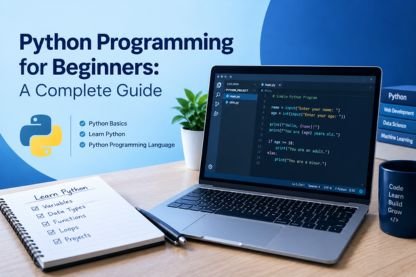
Python has gained popularity as a programming language due to its easy-to-read syntax, versatility and applicability in numerous areas. You can use this language for web development, automating tedious tasks, data analysis, and machine learning. Additionally, Python code is humanly readable which makes it ideal for beginners. The article Python Programming for Beginners covers the basics of the Python programming language including its nature, the key concepts that beginners should learn and how to effectively learn the language.
What Is the Python Programming Language?
Python is a high-level and general-purpose programming language that uses an easy-to-read syntax. This language enables developers to create computer programs that manipulate and execute instructions to perform a wide range of tasks.
Unlike other programming languages, Python syntax is simple to use and understand. Python is used in a wide range of applications including web development, data science, automation, and machine learning. For instance, using this language, you can display a simple message as:
python
print(“Hello, World!”)
When this instruction is executed in a Python compiler, it produces the following output:
text
Hello, World!
This is a simple demonstration of how easy it is to start writing codes in Python.
Why Should Beginners Learn Python?
Python Programming for Beginners is ideal for several reasons.
1. Easy-to-learn syntax
Python syntax is simple and readable making it easy for beginners to start coding. The instructions and statements are intuitive and closely resemble the English language. This way, beginners can easily comprehend what they write instead of dealing with complicated syntax.
2. Wide range of application
Python is used in a wide range of applications including web development, data science, and automating repetitive tasks. This language has numerous libraries that enable developers to build applications without having to reinvent the wheel. Additionally, learning this programming language can serve as a solid foundation for exploring several other languages.
3. Abundance of libraries
Python has a library for every application domain. These libraries offer readily usable functions that enable developers to build applications faster. Some of the most common libraries in Python include Pandas and Numpy.
4. Hands-on projects
The best way to learn any programming language is through practice. In Python, beginners can start by developing simple projects such as calculators, file organizer and games.
5. Foundational concepts
Python includes several foundational concepts such as data types, variables, loops and conditional statements. Learning these concepts enables one to develop a solid foundation for learning other programming languages.
Essential Python Basics Every Beginner Should Know
Before diving into Python application development, it is important to understand some of the basic concepts and syntax. These concepts include:
1. Variables and Data Types
Variables enable programs to store data values. A variable stores information and is used to reference the stored value. In Python, variables can store different data types including strings, integers, float and boolean. The following example demonstrates Python variables and data types:
python
name = “Aman”
age = 20
height = 5.8
is_student = True
print(name)
print(age)
In this example, the variables store different data types. The name stores the string, age stores an integer, height stores a float and is_student stores a boolean value.
2. Operators
Python includes different operators which enable one to perform specific operations. These operators include arithmetic, assignment, comparison, logical and bitwise operators. The arithmetic operators help to perform basic mathematical operations such as addition and subtraction. The following example demonstrates some of the arithmetic operators:
python
a = 10
b = 5
print(a + b)
print(a b)
print(a > b)
The output of the code is:
text
15
50
True
3. Conditional Statements
Conditional statements help programs to make decisions. Using these statements, programs can perform different operations depending on specific conditions. The following example demonstrates how conditional statements work:
python
marks = 75
if marks >= 40:
print(“Pass”)
else:
print(“Try again”)
This code determines if the specified marks are pass or fail. If the value of the variable marks is equal to or greater than 40, the decision is pass.
4. Loops
Python loops enable programs to repeat a set of statements. In other words, loops help execute a block of code multiple times. There are two main loop types in Python which are the for loop and while loop. The following example demonstrates the basic syntax of a for loop:
python
for number in range(1, 6):
print(number)
This loop will print numbers from 1 to 5. The loop runs until the condition is met. Loops are useful for automatically repeating a set of instructions.
5. Functions
Functions are independent blocks of code that can be used to perform specific tasks. This programming concept is useful because it reduces the amount of code that one has to write when developing applications. The following example demonstrates how functions work:
python
def greet(name):
print(“Hello,”, name)
greet(“Aman”)
In this example, the function prints a name. The code defines a function named greet that takes a parameter called name. The function is then used to print a greeting message.
6. Lists and Dictionaries
Python includes built-in data structures called lists and dictionaries. These data structures help to organize data in programs. The following example demonstrates how lists and dictionaries work:
python
fruits = [“apple”, “banana”, “mango”]
student = {“name”: “Aman”, “age”: 20}
print(fruits[0])
print(student[“name”])
In this example, the first part of the code is a list that is used to store a list of fruits. The dictionary component stores student details as keys and values pairs.
How to Learn Python Step by Step
If you are wondering how to learn the Python programming language step by step, the following guide might be helpful:
Step 1: Install the python interpreter on a computer or use an online coding platform to start writing Python applications. A preferred code editor such as PyCharm should also be installed.
Step 2: Learn Python basic syntax and terms. These terms include operators, variables, functions, loops, conditional statements, and data types.
Step 3: Practice simple coding challenges. This is a crucial step because it enables you to apply the concepts that you have learnt. Some of the challenges include writing programs that perform addition and multiplication of numbers, comparing numbers and calculating the average of a set of numbers.
Step 4: Learn how to create and use data structures in Python. This component covers lists, tuples, sets, and dictionaries.
Step 5: Gain an in-depth understanding of file handling and error handling in Python.
Step 6: Learn the advanced concepts in Python programming.
Step 7: Identify a specific area of expertise to focus on such as data science, web development or data analysis.
The time it takes to learn Python programming varies depending on the time that one can dedicate to practicing the language. It is also important to note that one cannot master every aspect of Python at once. It is advisable to take it step by step and ensure that you fully understand each concept before moving on to the next level.
Python Programming for Beginners: Projects to Practise
on these projects, it is advisable to try to implement them on your own first. In case of errors, it is important to read the error messages and ensure that you understand their meaning. You can then go ahead and fix the errors. It is important to keep trying until the projects are working smoothly.Once the foundational concepts of Python have been mastered, it is time to start practising Python coding skills. Some of the Python beginner-friendly projects include:
- Simple calculator – This project enables one to put together variables, operators, and Python functions.
- Number guessing game – This is a simple game that requires one to implement loops, conditional statements and random number generators.
- To-do list – This project helps to demonstrate how to store information, retrieve and update it.
- Student marks calculator – This project focuses on implementing conditional statements and calculations.
- File organizer – This project involves implementing simple file management tasks.
- Quiz application – This project enables one to implement dictionaries, conditional statements and score tracking features.
When working on these projects, it is advisable to try to implement them on your own first. In case of errors, it is important to read the error messages and ensure that you understand their meaning. You can then go ahead and fix the errors. It is important to keep trying until the projects are working smoothly.
Career Opportunities After Learning Python
Learning the Python programming language can open up various career opportunities. The language has several applications, thus developers can consider different career options. Some of the careers include:
- Python Developer
- Web Developer
- Data Analyst
- Automation Specialist
- Machine Learning Engineer
It is also important to note that one needs to invest time and effort to learn the Python language. Additionally, to be a successful Python Developer, it is not enough to just know the language. One also needs to have practical skills and a good portfolio. Employers also look for soft skills such as communication and leadership. It is important to identify one’s strengths and invest more time in building and developing those skills.
Learn Python With Structured Guidance
Whether you choose self-study or a structured learning path to learn Python, regular practice is essential. However, for some people, guided practice can be better than self-practice.
If you want to learn Python with guidance, you can consider the Python course in Chandigarh offered by the Rightouch Academy. The course syllabus will give you an idea of what the course entails. It is advisable to research more about the course and its offerings before making a final decision.
Regardless of the approach that you choose to learn Python, it is vital to ensure that you constantly practice and implement every concept that you learn.
Common Mistakes Beginners Should Avoid
Newcomers to Python programming often make several mistakes that hinder their progress. Some of the common mistakes that Python beginners should avoid include:
Watching tutorial videos without practicing
While tutorial videos are helpful and informative, it is important to practice by writing actual codes.
Trying to master advanced concepts without building a strong foundation
Many beginners rush to advanced concepts such as creating machine learning models. These developers overlook foundational concepts such as data types, operators and variables.
Copying code from other developers without fully understanding it
Before implementing codes from other developers, it is important to fully understand what the code does. This way, it will be possible avoid unnecessary errors. Another alternative is to tweak the copied code to meet your needs.
Skipping error messages
Error messages indicate what goes wrong in the code. Every error message should be investigated and the cause should be identified. Once the cause of the error has been identified, it should be removed for the code to run smoothly.
Trying to develop complex applications from the onset
Building complex applications requires advanced programming concepts. At this point, developers already know how to implement basic concepts such as variables, loops and conditional statements. It is, therefore, important to start with simple projects and gradually move to complex applications.
Giving up easily
Like any other skill, Python programming requires consistent practice. As a result, it is important not to give up easily. If a particular concept is not understood, it is important to seek further information and clarification.
Conclusion
Python Programming for Beginners , who are interested in data science, software development, or automation. This article covers Python basics including data types, variables, loops, conditional statements, functions and data structures. It is important to always practice the concepts that are covered in this guide. By investing time and effort in learning Python, one can gain valuable insight and develop practical skills in Python programming.